Aircraft Hydraulics and Landing Gear Training at Coleg Gwent
Coleg Gwent is one of the largest further education colleges in Wales, with five campuses across South East Wales. To give its aerospace engineering learners hands-on work on aircraft hydraulic systems, the college bought the Aircraft Maintenance Trainer (AERO-MINI) from French manufacturer ID System Didactic through Edquip.
The AERO-MINI hydraulic training unit is used at the HiVE Engineering Campus in Ebbw Vale to support learners on two Level 3 engineering programmes.
On Coleg Gwent’s Aerospace Engineering programme, the equipment supports the Airframe Mechanical Systems unit, where learners study the design, operation and control of aircraft landing gear and flight control systems.
The training rig is also used on the college’s Enhanced Engineering programme, where learners undertake practical activities involving hydraulic systems, developing their understanding of hydraulic components, circuits, operation and fault finding.
The bench combines a hydraulic power unit, a working landing gear, gear door and flap mechanism, and a teacher-only fault panel. Students build the circuits, run the sequences and find the faults themselves.
This is Coleg Gwent’s second project through Edquip, after the solar thermal trainer for T Levels in 2023. Browse the full range of aviation maintenance training equipment on Edquip, or see the product used in this project at the bottom of this page.


Challenge
Teaching aircraft hydraulics without an aircraft
Hydraulic power (ATA 29) and landing gear (ATA 32) are core topics for anyone heading into aircraft maintenance. They sit in Module 11 of the Part-66 licence syllabus, which the UK Civil Aviation Authority runs as UK Part-66 and EASA runs across the EU.
Colleges rarely have an aircraft to train on. Real aircraft components are expensive and hard to use in a teaching workshop. A standard industrial hydraulics bench covers pressure and flow, but not how an aircraft sequences its gear doors and landing gear, or how a technician works from maintenance manuals and cockpit indications.
A college in this position needs equipment that:
- uses a real hydraulic circuit that students connect themselves
- runs the door, gear and flap sequence the way an aircraft does, with position indications
- lets lecturers set faults that students have to find
- is safe for learners working near pressurised hoses
- comes with documentation in an aviation format
Coleg Gwent’s brief was specific: Level 3 training equipment for landing gear and control surface operation.
Solution
A compact aeronautical hydraulics bench
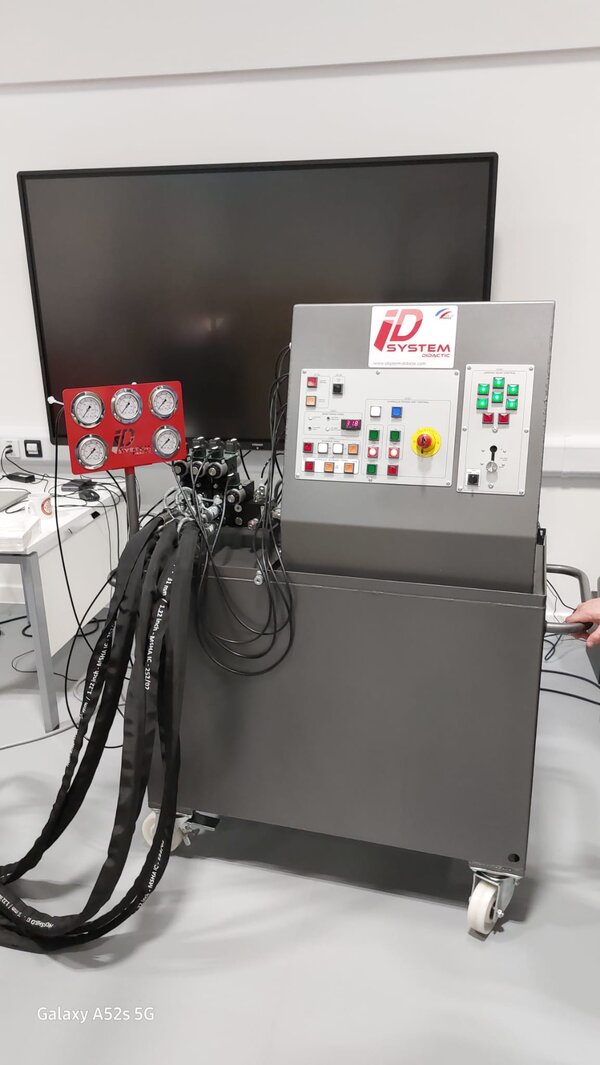
Coleg Gwent chose the AERO-MINI, the compact version of ID System Didactic’s aeronautical maintenance bench. ID System developed it with a French National Education teacher who was previously a mechanical engineer in the French Air Force. It consists of two mobile units connected by hydraulic hoses and electrical cables.
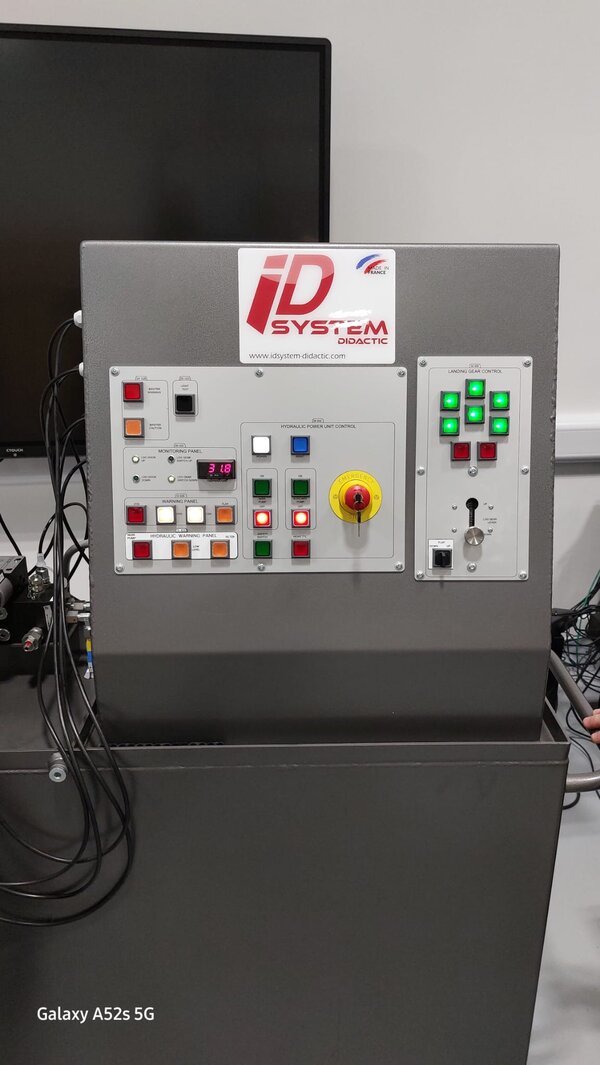
Hydraulic control and power unit (PCA-V3-MINI). A 1.5 kW motor drives a gear pump (6 l/min) from a 22-litre tank. The main circuit is limited to 80 bar and the auxiliary circuit to 60 bar. A CETOP 3 valve stack controls the landing gear, the gear door and the flap, with pressure test points on each line. A PLC-controlled electrical cabinet with a lockable disconnector and emergency stop runs the system.
The control desk is laid out like an aircraft system panel:
- main and auxiliary pump controls
- a hydraulic warning panel for main pump, low tank level, low pressure and filter
- main and auxiliary pressure gauges (0–150 bar) with gear and door position lights
- a landing gear lever with six green and two red position indicators
- five extra pressure gauges that students connect to the test points
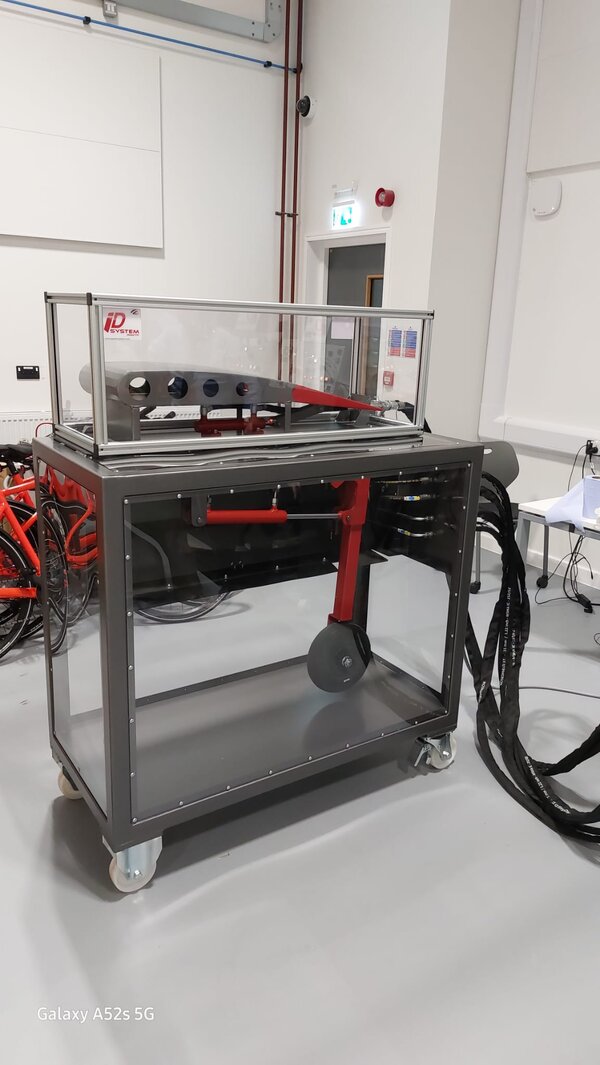
Landing gear unit (POTA-V2). This is a working mechanism, not a simulation. A hydraulic cylinder opens the gear door, a second cylinder lowers the gear, and the door closes again, following the same sequence used on most aircraft. Four sensors confirm each step before the next one can start. A flap module on top (a wing section with a hydraulically driven flap) adds a third system to control. The whole unit is enclosed in Lexan panels.
Fault finding. A locked trouble panel, accessible only to lecturers, lets them trigger electrical faults: gear, door or flap valve coils, main pump, low tank level, filter, and either landing gear indication light. Students see the symptom, then trace the cause.
A troubleshooting kit adds hydraulic faults. It is a case of deliberately defective CETOP 3 components, including a valve with a jammed spool, a burnt coil, a leaking pressure reducer and a check valve that will not open. Each part looks identical to the working one apart from an identification mark, so students have to diagnose the fault from how the system behaves.
Safety built in. Hoses have flat-face couplings with locking rings, protective sleeves and anti-whip cables. The moving parts are enclosed. Hydraulic and electrical safety devices are doubled, and the bench carries CE conformity under the Low Voltage, Machinery, EMC and Pressure Equipment directives.
Aviation-format documentation. The English documentation, supplied on paper and digitally, includes an Aircraft Maintenance Manual and a Troubleshooting Manual laid out in ATA 100 chapter format. It also includes commissioning, operating and maintenance instructions, and practical exercises on pressure, flow, pressure drop, contamination and filtration, and hydraulic safety.
ID System maps the bench to these ATA chapters: servicing (ATA 12), electrical power (ATA 24), hydraulic power (ATA 29), landing gear (ATA 32) and information systems (ATA 46). The practical skills it covers include:
- using technical documentation
- securing a hydraulic circuit before work
- preparing an intervention
- assembling, disassembling and setting subassemblies
- testing and troubleshooting
- inspecting an aircraft part
- reporting in an aeronautical context
Results
Hands-on aircraft systems training in a college workshop
Currently, approximately 20–30 learners per year use the AERO-MINI training unit across the two programmes, although this number is expected to change as the programmes develop.
The equipment enables lecturers to reinforce theoretical classroom learning with realistic practical activities. Aerospace learners can see and operate a representative aircraft landing gear and control surface hydraulic system rather than relying solely on diagrams, photographs and videos.
For learners on the Enhanced Engineering programme, the rig provides practical experience of hydraulic system operation and fault finding. Introducing faults allows learners to follow a logical diagnostic process, interpret system behaviour and identify the cause of a problem. This helps them understand how individual hydraulic components interact as part of a complete system and develops practical problem-solving skills that are difficult to achieve through theory alone.
The practical experience also supports learner performance by allowing students to apply the principles covered in their classroom work and provides useful evidence and understanding for their assessed units.
With the AERO-MINI, Coleg Gwent lecturers can:
- take learners from a hydraulic circuit diagram to a working landing gear sequence on one bench
- set faults without warning and assess how learners diagnose them
- teach from an AMM and TSM, the same kind of documents used in hangar work
- cover the hydraulic hazards of the job, such as pressure, contamination and hose failure, on a bench designed to contain the

